A couple of years ago I was sitting in a tiny Airbnb in Lisbon, refreshing LinkedIn every twenty minutes, wondering why I’d sent out forty applications and heard back from exactly two. I had a decent CV. I spoke English fluently and passable Spanish. On paper I looked employable. But I kept getting the same polite rejection: “we’ve decided to move forward with other candidates whose profile more closely matches our current needs.”
It took me way too long to figure out what “current needs” actually meant. I was applying with skills that were useful five years ago, not skills companies were desperately trying to fill right now. Once I sat down and actually mapped out what European employers were begging for, everything changed. I landed a remote-friendly contract within six weeks of shifting my focus, and I’ve spent enough time since then talking to recruiters, immigration consultants, and other expats to know my experience wasn’t a fluke.
So this is the article I wish someone had handed me back then. Not a generic “learn to code” pep talk, but an honest breakdown of what’s actually getting people hired across Europe right now, based on what I’ve seen work and what’s wasted my time.
Why This Even Matters (and Why It’s Different From the US or Asia)
Europe’s job market runs on a slightly different engine than what you might be used to. There isn’t one “European economy” — Germany’s manufacturing sector wants something completely different from what a Lisbon fintech startup wants, and Poland’s booming IT outsourcing scene has its own rhythm entirely.
But there are a few big forces pulling in the same direction almost everywhere on the continent:
- An aging population. Countries like Germany, Italy, and Spain have workforces that are shrinking faster than they can replace them, especially in healthcare and skilled trades.
- A genuine digital skills gap. Businesses across every sector, not just tech companies, are trying to digitize and just don’t have enough people who know how.
- The green transition. The EU’s push toward net-zero has created real hiring demand in renewable energy, EV technology, and sustainability roles, not just PR fluff.
- Labour shortage lists. The EU actually publishes an official shortage occupation list, and individual countries like Germany and Ireland have their own “bottleneck” lists that make visas easier to get for certain roles.
Once I understood that last point, job hunting stopped feeling random. It became a matter of matching my skills to an actual, documented shortage instead of guessing.
The Skills That Kept Coming Up Over and Over
Here’s the part you actually came for. I’m splitting this into tech and non-tech because honestly, one of my biggest early mistakes was assuming “in demand skills” only meant coding.
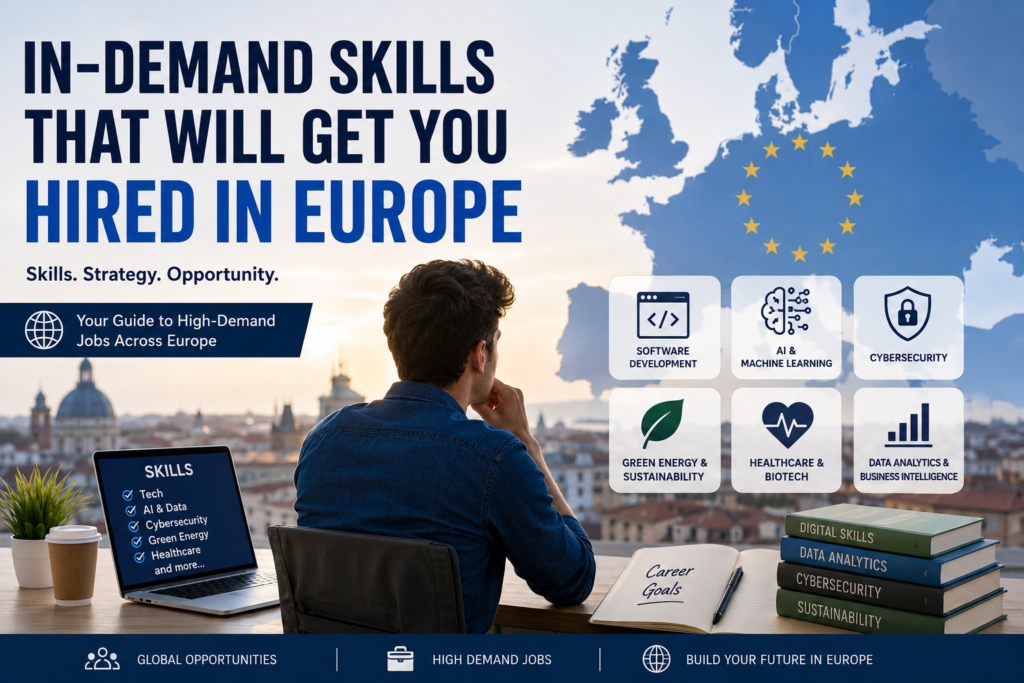
1. Software Development (Still King, But More Specific Than Ever)
I know, I know — “learn to code” is the most overused advice on the internet. But the nuance matters. Generic “I know a bit of everything” developers struggle. What’s actually getting people interviews is depth in specific stacks: backend work in Java or Python, cloud-native development on AWS or Azure, and increasingly, developers who can work comfortably alongside AI tools rather than being replaced by them.
Germany, the Netherlands, and Poland are absolute magnets for this right now. I met a backend developer in Berlin who told me he had three recruiter messages in his inbox before he’d even finished his coffee that morning. That’s not an exaggeration I’m making up for effect — I saw the notifications.
2. AI and Machine Learning Skills
This is the one that surprised me the most. It’s not just “AI Engineer” as a job title anymore. Companies in retail, logistics, and even agriculture are hiring people who understand how to apply machine learning models to real business problems — not necessarily people who can build a model from scratch, but people who can prompt, fine-tune, evaluate, and integrate existing tools like OpenAI’s API, Anthropic’s Claude, or open-source models into workflows.
If you’re not a hardcore ML researcher, don’t panic. A lot of the demand right now is for “AI-literate” generalists: marketers who can automate reporting, analysts who can build a working prototype without waiting six months for the engineering team.
3. Cybersecurity
Every single recruiter I spoke to mentioned this one unprompted. As more European companies digitize (often for the first time, especially smaller manufacturers and family businesses), they’re realizing they have zero protection against basic attacks. Roles around cloud security, penetration testing, and compliance (especially GDPR-related work) are chronically understaffed.
A friend of mine switched from general IT support to a cybersecurity-focused certification path (she did the CompTIA Security+ and later moved into cloud security certs) and doubled her salary within eighteen months. She didn’t have a computer science degree. She had a support desk background and a willingness to study on weekends.
4. Data Analysis and Data Science
This one is everywhere, and it’s less intimidating than it sounds. You don’t need to be a PhD statistician. Companies want people who can take messy spreadsheets and dashboards and actually explain what they mean to a non-technical manager. Comfort with Python or R, SQL, and a cloud platform (AWS or Azure are the two I saw referenced most) puts you ahead of a huge chunk of applicants.
5. Renewable Energy and EV-Related Trades
This is where I think a lot of people miss an opportunity because it doesn’t sound as glamorous as “AI Engineer.” But EV technicians, solar and wind installation specialists, and power systems engineers are in serious demand, particularly in Germany, France, and the Nordic countries. These aren’t remote desk jobs, but they often come with strong salaries, union protections, and clear training-to-employment pipelines.
6. Healthcare (Nurses, Healthcare Assistants, Care Workers)
If you’re in nursing or allied health, you genuinely have your pick of countries right now. Germany, the UK, and several Nordic countries have active recruitment campaigns actively courting nurses from abroad, sometimes with relocation support and language training built in. It’s not an easy path (licensing recognition can be a real headache, more on that below), but the demand is not exaggerated.
7. Skilled Trades (Electricians, Welders, HVAC Technicians)
I almost left this off the list because it’s not what people picture when they hear “in-demand skills,” but it deserves to be near the top. Construction and infrastructure investment across Europe means there’s a real, persistent shortage of qualified tradespeople. If you already have a trade certification, several countries have simplified pathways to get your qualifications recognized.
8. Multilingual Communication
This isn’t a “skill” in the flashy sense, but it came up constantly. A huge share of European companies specifically prefer candidates who speak more than one language, particularly for customer-facing, sales, or HR roles. English plus one more European language (German and French are the most requested in my experience) puts you in a noticeably smaller applicant pool.
9. Adaptability and “Soft Skills” (Yes, Really)
I used to roll my eyes at this category too, until multiple hiring managers told me directly that they’ll pick the adaptable, communicative candidate with slightly weaker technical skills over the technically brilliant person who can’t collaborate. Emotional intelligence, cross-cultural communication, and comfort with ambiguity are things recruiters actively screen for now, especially for anything client-facing or cross-border.
How I’d Actually Go About Building These Skills (Step by Step)
Here’s the process I used, adjusted with everything I’d do differently if I started over.
Step 1: Check the actual shortage lists before you pick a direction. Don’t guess. The EU publishes shortage occupation data, and EURES (the official European job mobility portal) has country-by-country breakdowns. Germany’s “bottleneck profession” list and Ireland’s Critical Skills list are both public and specific. Five minutes of reading here will save you months of wasted studying.
Step 2: Pick one lane, not five. My first mistake was trying to dabble in data analysis, cybersecurity, and digital marketing all at once. I ended up mediocre at all three. Pick one, get genuinely competent, then branch out later once you have income coming in.
Step 3: Get a real certification, not just a course completion badge. Platforms like Coursera, LinkedIn Learning, and freeCodeCamp are great for learning, but employers in Europe (especially for visa-sponsored roles) often want something recognized: AWS or Azure certifications for cloud roles, CompTIA or (ISC)² for cybersecurity, or formal nursing/trade license recognition through the relevant national body.
Step 4: Build something you can point to. For tech roles specifically, a portfolio matters more than a certificate. I built two small projects (a data dashboard and a basic automation script) and put them on GitHub. Recruiters mentioned them in almost every interview. Nobody asked about my unfinished online courses.
Step 5: Learn the language basics, even if the job is “English-speaking.” I underestimated this badly. Even in companies that officially operate in English, speaking even broken German or French in an interview visibly changed how I was received. You don’t need fluency. Duolingo or Babbel for six months gets you enough to show effort, and effort matters here.
Step 6: Use the right visa pathway for your situation. If you’re not an EU citizen, this part is not optional homework, it’s the actual gatekeeper. The EU Blue Card is the main route for skilled professionals with a degree or strong professional experience. Germany’s Opportunity Card lets you enter to job-hunt without a job offer first, based on a points system. Ireland has its own Critical Skills Permit. Look these up specifically for the country you’re targeting, because the requirements are not interchangeable.
Step 7: Apply through the right channels, not just job boards. EURES is worth using specifically because it’s designed for cross-border EU job matching. LinkedIn and Indeed work too, but I got far more traction reaching out directly to recruitment agencies that specialize in relocation, since they already understand the visa maze and won’t waste your time on companies unwilling to sponsor.
Mistakes I Made (So You Don’t Have To)
I applied to jobs before checking if my qualifications would even be recognized. I wasted three weeks pursuing a role that required a licensed credential my home-country certificate didn’t automatically satisfy. Check recognition requirements before you fall in love with a job posting.
I assumed remote work would be easy to find. It’s more available than a few years ago, but plenty of “remote” European roles still legally require you to be a tax resident in a specific country. I got excited about a role, made it to the final interview, and found out I’d need an EU work permit anyway.
I underestimated how much soft skills mattered in interviews. I over-prepared technical answers and under-prepared for the “tell me about a time you disagreed with a colleague” style questions that came up constantly.
I ignored trades and healthcare because they didn’t feel “modern.” In hindsight, some of the fastest, most stable paths to European employment I saw other people take were in nursing, welding, and electrical work, not tech.
I didn’t network with people already living there. Once I started actually messaging people on LinkedIn who’d made the same move, I learned more in a week than I had in two months of solo research. Facebook expat groups and subreddits for specific cities are underrated for this.
Real Examples Worth Knowing
A guy I met in a coworking space in Porto moved from a general IT support role in the Philippines to a cloud security position in the Netherlands within about a year, using the Highly Skilled Migrant scheme after getting an AWS Security certification and applying through a relocation-focused recruitment agency.
A nurse I know moved from the Philippines to Germany through a structured recruitment program that included German language training before departure, sponsored partly by the hospital that hired her.
A former marketing coordinator I worked with taught herself basic Python and SQL through free YouTube tutorials and a few Coursera courses, then got hired into a junior data analyst role at a Berlin startup that didn’t require a computer science degree, just a working portfolio and the ability to explain her thinking clearly in the interview.
None of these people started with everything figured out. They picked a lane, filled the specific gap employers were struggling with, and stuck with it.
Final Thoughts
If there’s one thing I’d want you to take away from all this, it’s that “in demand” isn’t the same as “trendy.” AI and cybersecurity get all the headlines, but electricians, nurses, and multilingual customer service reps are just as wanted, sometimes more urgently, in specific countries. The real trick isn’t chasing whatever’s hyped on LinkedIn that week. It’s matching what you’re actually good at, or willing to get good at, against what a specific country and sector is genuinely short on.
Check the shortage lists. Pick a lane. Build something real you can show. And don’t skip the boring visa paperwork research, because that’s usually what actually decides whether any of this works out.