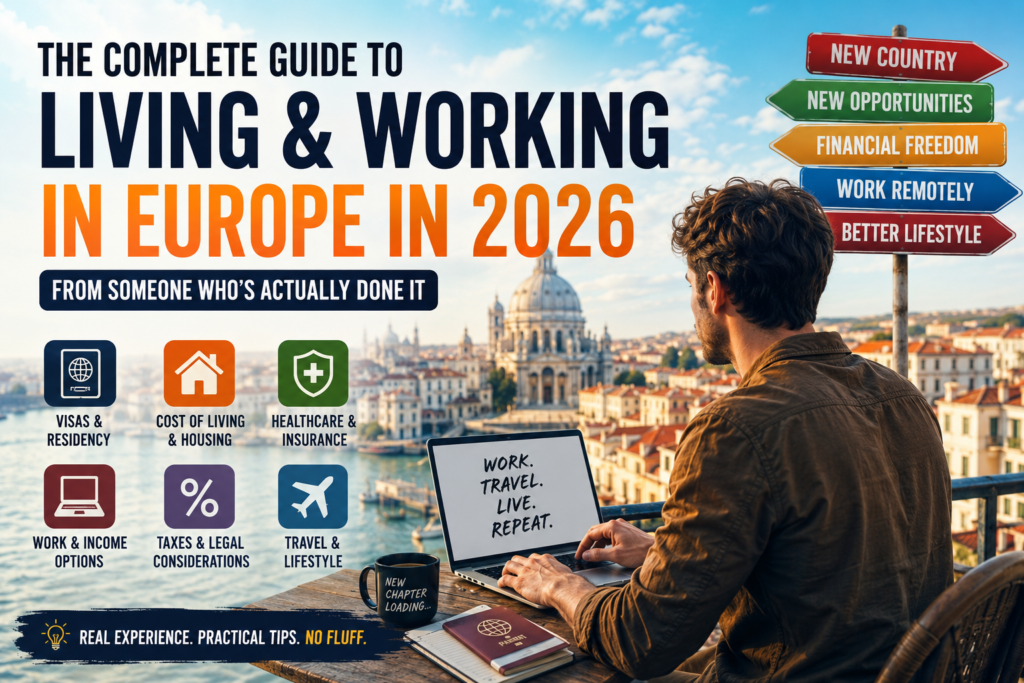
I still remember sitting in a tiny Airbnb in Lisbon back in early 2023, staring at my laptop, trying to figure out why my Portuguese bank transfer had bounced for the third time. My rent was due in two days, my landlord wasn’t responding to WhatsApp messages, and I had exactly zero idea how the NIF number I’d been told I “absolutely needed” actually worked.
That mess turned into three years of bouncing between five European countries, two visa rejections, one very expensive lesson about health insurance, and eventually a setup that actually works. If you’re thinking about making the move to Europe in 2026, either to work remotely, take a local job, or just start a completely new chapter — I want to save you the headaches I went through.
This isn’t a “10 dreamy reasons to move to Europe” listicle. This is the stuff nobody tells you until you’re already there and panicking.
Why 2026 Is Actually a Different Game Than a Few Years Ago
Europe changed a lot post-pandemic in how it treats remote workers and skilled migrants. Countries that used to ignore digital nomads now have entire dedicated visa categories for them. At the same time, some countries tightened up rules because housing got tight in cities like Lisbon, Barcelona, and Amsterdam, and locals started pushing back on rent prices being driven up by foreign remote workers.
So the landscape now is a mix of “come on in, we want you” and “please don’t make our housing crisis worse.” Knowing which country falls where matters more than people think.
A few things that are genuinely different in 2026:
- More countries now require proof of private health insurance that meets specific coverage minimums, not just “any insurance.”
- Digital nomad visa income thresholds went up in several countries to account for inflation.
- The EU’s new short-stay Schengen tracking system (EES) is now fully rolled out at most border crossings, which means overstaying is far easier for authorities to catch than it used to be.
- Remote-work friendly tax treaties are being enforced more strictly, so the old trick of “just don’t tell anyone I’m working remotely” doesn’t fly anymore.
None of this is meant to scare you off. It just means you need to actually plan instead of winging it, which is exactly what I did the first time and paid for.
Step 1: Figure Out Which “Path” You’re On
Before you even think about apartments or flights, you need to know which category you fall into, because it completely changes your paperwork.
Path A — EU/EEA/Swiss citizen. You basically have it easy. Freedom of movement means you can live and work in almost any EU country without a visa. Your main job is registration paperwork once you arrive, not visa applications.
Path B — Remote worker for a non-European company. This is the group that exploded over the last few years. You’re not taking a local job; you’re bringing your income with you. Countries like Portugal, Spain, Croatia, Greece, and Estonia have specific digital nomad visas built for this exact situation.
Path C — Getting hired locally by a European company. This usually means a work permit tied to an employer, and often a points-based or labor-market test process, especially outside the EU Blue Card system.
Path D — Highly skilled professional (EU Blue Card route). If you’ve got a university degree and a job offer above a certain salary threshold, the EU Blue Card is worth looking into. It’s designed to make it easier for skilled workers to move around within the EU after the first two years.
I was firmly in Path B for most of my time abroad, so a lot of what follows leans that direction, but I’ll cover the others too.
Step 2: Pick Your Country Like You’re Choosing a Roommate, Not a Vacation Spot
This is where I made my biggest mistake. I picked Portugal because I loved it on a two-week holiday. Turns out loving a place as a tourist and being able to actually function there as a resident are two very different experiences.
Here’s what actually matters when picking a country to live and work in:
Cost of living versus your actual income. Lisbon and Porto aren’t the cheap secret they were five years ago. Prices have gone up a lot, especially rent. Cities like Valencia, Tbilisi (not EU but popular with remote workers), Riga, and parts of Poland still offer a much better cost-to-quality ratio.
Language reality, not language fantasy. “Everyone speaks English” is true in coworking spaces and cafes in touristy areas. It is not true at the tax office, the health clinic, or your local pharmacy. If bureaucracy stresses you out, prioritize countries with strong English-language government services, like the Netherlands or the Nordic countries.
Visa renewal difficulty. Some countries make renewals painless online. Others require you to physically show up, take a number, and wait four hours in a room with no air conditioning. Ask in expat Facebook groups or Reddit communities like r/expats before committing.
Tax residency rules. If you spend more than roughly 183 days in most countries, you become a tax resident there, which triggers local tax obligations on your worldwide income unless a tax treaty says otherwise. This trips up so many remote workers because they don’t realize it until tax season.
Step 3: The Actual Visa Process (Using Portugal’s D8 Digital Nomad Visa as a Real Example)
I’ll walk you through what I actually did, because reading a government website summary and living through the process are very different.
1. Gather proof of income. For Portugal’s D8 visa, you generally need to show income of around four times the Portuguese minimum wage per month, sourced from outside Portugal. I used a combination of bank statements and a signed letter from my main client confirming ongoing work.
2. Get private health insurance that covers you in Portugal. I used a policy through SafetyWing at first because it was quick to set up, then switched to a local Portuguese provider once I had residency, since it worked out cheaper.
3. Get your NIF (tax number). This is the single most important piece of paper in Portugal. You cannot open a bank account, sign a lease, or get a phone contract without it. You can get one through a Portuguese tax representative if you’re not yet in the country, which is what I should have done from day one instead of trying to sort it out after arriving.
4. Open a local bank account. I used a mix of a Portuguese bank (Millennium BCP) for local bills and Wise for moving money internationally without getting destroyed on exchange rates.
5. Book your visa appointment at the consulate in your home country, or apply through the newer online portal if your consulate supports it. Appointments can book out months in advance, so this is not a “sort it out next month” task.
6. Land, then register your residency permit (AIMA appointment in Portugal’s case) within the required window. This step used to be handled by SEF; it’s now AIMA, and appointment availability has genuinely been a nightmare for a lot of people. Book the moment you’re allowed to.
Every country has its own version of this dance. Spain has the “Visado de Nómada Digital.” Croatia has a simpler digital nomad residence permit with no minimum stay requirement to apply. Estonia’s digital nomad visa is well documented and has one of the more straightforward online processes I’ve dealt with.
The Money Stuff Nobody Explains Properly
Banking: Get a multi-currency setup before you land, not after. I use Wise for holding and converting currencies, and Revolut for day-to-day spending since it integrates well with local payment systems like Multibanco in Portugal or Bizum in Spain. Opening a fully local bank account is still worth doing eventually, mainly because some landlords and utility companies won’t accept anything else for direct debits.
Taxes: This is where I’d genuinely recommend paying for a local accountant your first year, even if it stings. I tried to DIY my Portuguese NHR (Non-Habitual Resident) tax status application and got the paperwork wrong, which cost me months of back-and-forth. A local accountant who deals with expats specifically will know exactly which forms matter.
Health insurance: Don’t cheap out here. A basic travel insurance policy is not the same as the private health insurance most visa applications require. Look for policies that explicitly state they meet Schengen visa or local residency requirements, with a minimum coverage amount usually around 30,000 euros.
Common Mistakes I See Constantly (Because I Made Most of Them)
Assuming the tourist experience predicts the resident experience. Loving somewhere on holiday tells you almost nothing about grocery shopping, healthcare, or dealing with the post office there.
Underestimating bureaucracy timelines. Government appointment slots, especially for residency registration, can be booked out for months. Apply and book the moment you’re eligible, not when it’s convenient.
Not checking tax treaty details between your home country and your new country. Double taxation is avoidable in most cases, but only if you actually understand the treaty terms and file correctly.
Renting long-term without seeing the place first. I got burned once by a “furnished apartment” listing that turned out to be one mattress on the floor and a hot plate. Always try to book a short-term stay first, then apartment hunt in person once you’re there.
Ignoring local job market realities if you’re on Path C or D. Some industries in Europe genuinely value experience over flashy resumes. Tech, engineering, healthcare, and skilled trades tend to have real demand. Sales and marketing roles are far more competitive for non-local candidates, mainly due to language requirements.
Forgetting about winter. This sounds silly, but a lot of people move somewhere sunny for the summer vibe and completely underestimate how different a place feels in a grey, rainy February.
Finding Work Once You’re There (Or Before You Go)
If you’re going the Path C or D route and want a locally-based job, here’s what actually worked for me and people I know:
- EURES (the EU’s official job mobility portal) is genuinely useful for finding roles that are open to non-local applicants and gives clear info on which employers sponsor work permits.
- LinkedIn, obviously, but tailor your profile location and headline to the country you’re targeting. Recruiters filter by location constantly.
- Local job boards matter more than people expect. Germany has StepStone, France has Welcome to the Jungle, and the Netherlands has Indeed NL alongside more localized boards.
- Coworking spaces turned out to be one of the best networking tools I had. I found two client contracts just from conversations at a coworking space in Porto.
If you’re freelancing or running your own business remotely, tools like Xolo (great for handling Estonian e-Residency company setups) or a local equivalent can simplify invoicing and tax admin significantly.
What a Realistic First Three Months Actually Looks Like
Week 1–2: Landing, temporary accommodation, getting a local SIM card, opening initial banking access.
Week 3–4: Apartment hunting, signing a lease (expect to need proof of income, sometimes a guarantor, and a deposit of one to three months rent).
Month 2: Residency registration appointments, setting up local healthcare access, finding a local accountant if needed.
Month 3: This is usually when it starts to feel normal instead of overwhelming. You know your grocery store, you’ve figured out public transport, and the paperwork panic has mostly faded.
It’s rarely a smooth straight line. I had weeks where everything felt broken and weeks where it felt effortless. That’s normal.
Final Thoughts
Moving to Europe in 2026 is absolutely still worth it for a lot of people, but it’s not the Instagram-filtered version everyone posts about. It’s spreadsheets, tax numbers, waiting rooms, and slowly building a life piece by piece.
The people who do it successfully aren’t the ones with the most money or the perfect plan. They’re the ones who stay patient through the boring admin stuff, ask questions in local expat communities before assuming, and treat the first few months as a learning period instead of expecting it to feel like home right away.
If I could go back and tell myself one thing before that first bounced bank transfer in Lisbon, it would be this: get your paperwork sorted before you fall in love with the place. The love comes easier once the stress is out of the way.