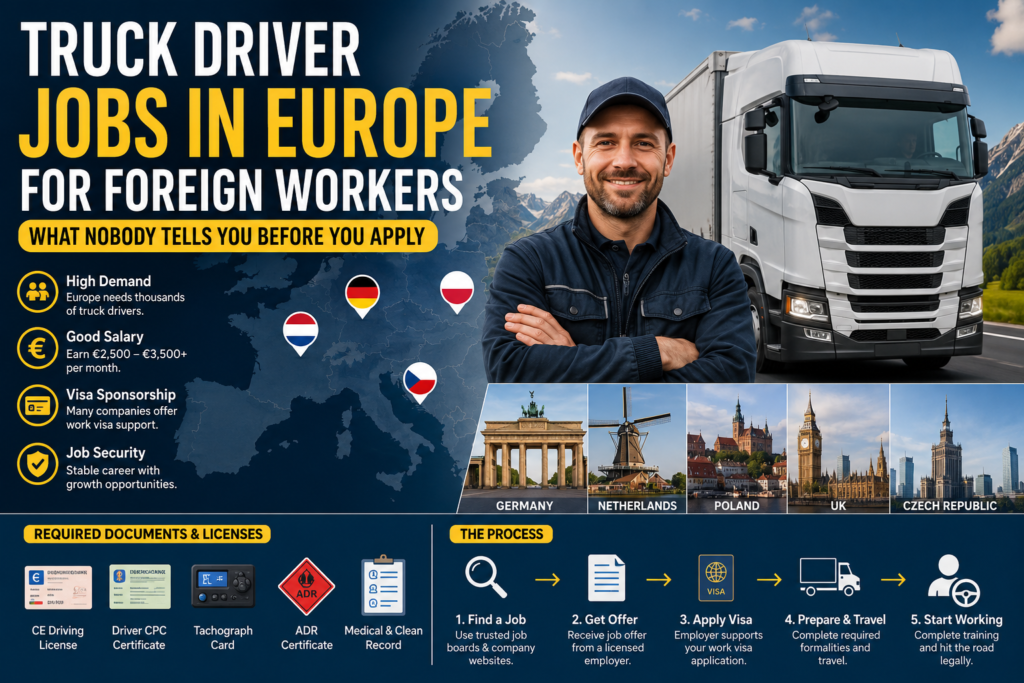
A few months ago, my cousin called me at almost midnight, all excited. He’d just seen a Facebook ad promising “Truck Driver Jobs in Germany – €3500/month – Visa Sponsorship Guaranteed!” He was ready to pay some “agency” 800 euros on the spot to “process his papers.”
I talked him out of it that night. Not because the dream is fake — plenty of foreign drivers really are working legally across Europe right now, earning solid money. But because that specific ad had every red flag you can imagine, and he almost got scammed chasing something that, done right, is actually achievable.
That conversation is basically why I’m writing this. I’ve spent a good chunk of time helping people in my network navigate this exact process — some succeeded, some hit walls, a couple got burned. I want to walk you through what the real path looks like, not the Facebook-ad version.
Why Europe Actually Needs Foreign Truck Drivers
This isn’t hype. Countries like Germany, Poland, the Netherlands, and the UK have talked openly for years about a serious shortage of qualified truck drivers. Local workforces are aging out, fewer young Europeans want to do long-haul driving, and freight volume keeps growing.
That gap is real, and it’s the reason several EU countries have created simplified work-permit pathways specifically for drivers from outside the EU — places like Ukraine, Belarus, Georgia, the Philippines, India, and Pakistan have all sent drivers into European logistics companies in recent years.
But “there’s demand” doesn’t mean “anyone can just show up.” There’s a process, and skipping steps is exactly how people lose money or end up stuck.
The License Question Comes First
Before anything else — job search, visa, agency, whatever — you need to answer one question honestly: what license do you currently hold, and what will you need?
Most EU countries require:
- A valid Category C or CE driving license (C for rigid trucks, CE for trucks with trailers) recognized or convertible in the destination country
- A Driver CPC (Certificate of Professional Competence) — this is an EU-specific qualification, separate from your regular license
- A digital tachograph card — this records your driving hours and is mandatory for any EU commercial driver
- Often an ADR certificate if you’ll be hauling hazardous materials, since it usually pays better
Here’s the part people miss: your home-country license doesn’t automatically transfer. Some countries have bilateral agreements that let you convert it fairly easily. Others require you to essentially requalify — take local theory and practical tests, sometimes in the local language.
I’d strongly recommend checking the specific country’s transport ministry website or the EU’s official mobility portal before assuming anything. Requirements shift, and what was true two years ago for Poland might not be true today.
Where to Actually Look for Jobs (Skip the Facebook Ads)
This is where my cousin almost went wrong. Random social media ads promising guaranteed visas are, more often than not, either scams or middlemen taking a cut for information you can get for free.
Here’s what actually works:
1. EURES (European Employment Services) This is the EU’s own official job mobility platform. It’s free, it lists real vacancies from real employers across member states, and it has a specific section for jobs facing labor shortages — trucking shows up here constantly. Start here before anywhere else.
2. Trans.eu A major logistics-industry job and freight platform used widely across Central and Eastern Europe. Companies post driver vacancies directly, and you can filter by country and license type.
3. Direct company career pages Big logistics firms — DB Schenker, DHL, Girteka, DSV, and similar — regularly hire international drivers and list openings directly on their own sites. Applying directly cuts out a layer of middlemen entirely.
4. LinkedIn Sounds obvious, but recruiters for logistics companies are active there. Set your profile to show you’re open to relocation and driving roles, and you’ll start getting inbound messages — just verify every recruiter’s company independently before sharing documents.
5. National labor ministry job boards Germany’s “Make it in Germany” portal, Poland’s labor office listings, and similar government sites often list verified vacancies with visa-sponsorship details spelled out clearly.
A Realistic Step-by-Step Process
Based on what’s worked for people I know, here’s roughly how the legitimate path unfolds:
Step 1: Confirm your license situation. Figure out if your current license needs conversion or if you’re starting from scratch on a CE license and CPC.
Step 2: Get your documents in order. Passport validity, clean driving record certificate, medical fitness certificate, and any existing professional certifications translated and notarized.
Step 3: Search verified job boards, not social media. Start with EURES and direct company sites.
Step 4: Apply directly and ask specific questions. A legitimate employer will clearly explain visa sponsorship, contract length, salary structure, and accommodation — without asking you to pay anything upfront for the job itself.
Step 5: Once you have a job offer, apply for the work visa/permit. This is handled through the embassy or consulate of the hiring country, usually with the employer providing supporting documents.
Step 6: Arrange license conversion or local qualification, if required. Sometimes this happens before you travel, sometimes after arrival, depending on the country’s rules.
Step 7: Arrival and onboarding. Many companies run a short induction covering local road rules, tachograph software, and route systems before you’re out on your own.
It’s not fast. Realistically, from first application to actually driving a truck in Europe, people I know have taken anywhere from three to eight months, depending on the country and how quickly paperwork moves.
Real Scenarios That Show What This Actually Looks Like
Scenario one: A driver from Georgia applied through Trans.eu to a Polish logistics company. He already had a CE license and just needed his CPC card, which the company helped arrange locally after arrival as part of onboarding. Visa sponsorship was handled through Poland’s simplified work-permit process for drivers, since trucking is on their shortage-occupation list.
Scenario two: Someone I know from the Philippines went through a licensed recruitment agency (properly registered, checkable through the Philippine Overseas Employment Administration) for a placement in the Netherlands. The agency fee was capped by law and paid partly by the employer — a good sign, since legitimate placements rarely put the full financial burden on the worker.
Scenario three, the cautionary one: A driver from Pakistan paid an unregistered “agent” a large upfront fee for a promised German trucking job. The agent disappeared after payment. No job, no refund, no recourse. This is depressingly common, and it’s exactly the pattern to watch for.
Common Mistakes That Cost People Time and Money
Paying anyone upfront before verifying they’re legitimate. Real employers and registered agencies don’t need large cash payments before you’ve even got a contract. If someone’s asking for money just to “process” you, slow down and verify independently.
Assuming your license just works everywhere. It doesn’t. Check the specific country’s conversion rules before you make any plans.
Ignoring the language requirement. Some countries barely require any local language for driving jobs since routes are often international. Others, especially for jobs that involve more customer interaction or domestic routes, expect at least basic conversational ability. Don’t assume — ask directly.
Not reading the actual contract. Salary numbers in ads are often gross, not net, and sometimes don’t include accommodation deductions. Ask for the full breakdown in writing before accepting anything.
Skipping the CPC or tachograph training and hoping it works out. It won’t. These are mandatory, checked regularly, and driving without proper certification can get you fined or your employer sanctioned.
Trusting unofficial “guaranteed visa” claims. No agency or company can guarantee a visa outcome — that decision sits with the government issuing it. Anyone promising a 100% guarantee is either overselling or lying.
What the Money Actually Looks Like
I’ll be straight with you — exact numbers vary a lot by country, company, and experience level, and they shift with inflation and demand, so don’t take any single figure as gospel. Long-haul international drivers in Western Europe generally earn noticeably more than domestic-only drivers in Eastern Europe, and per-diem allowances for nights spent on the road often make up a meaningful chunk of total take-home pay.
Rather than trusting any number you read in a blog (including this one), check current listings on EURES or Trans.eu for the specific country you’re targeting — that gives you real, current figures rather than a stale average.
Final Thoughts
My cousin ended up going the slow, boring, unglamorous route — he checked EURES, found a real vacancy with a Polish company, applied directly, and is now actually driving routes across Central Europe. No guaranteed-visa Facebook ad, no upfront fee, no drama. Just paperwork, patience, and checking things twice before trusting them once.
That’s really the whole story with this path. The opportunity is genuinely there. Europe needs drivers, and plenty of countries have made room for foreign workers to fill that gap legally. But the people who get burned are almost always the ones who rushed, trusted the wrong source, or paid money before verifying anything.
If you’re serious about this, start with the boring stuff — your license status, the official job boards, the actual visa requirements for your target country. It’s slower than clicking “apply” on a sketchy ad, but it’s the version of this that actually gets you behind the wheel instead of out of pocket.